brokerPRIME
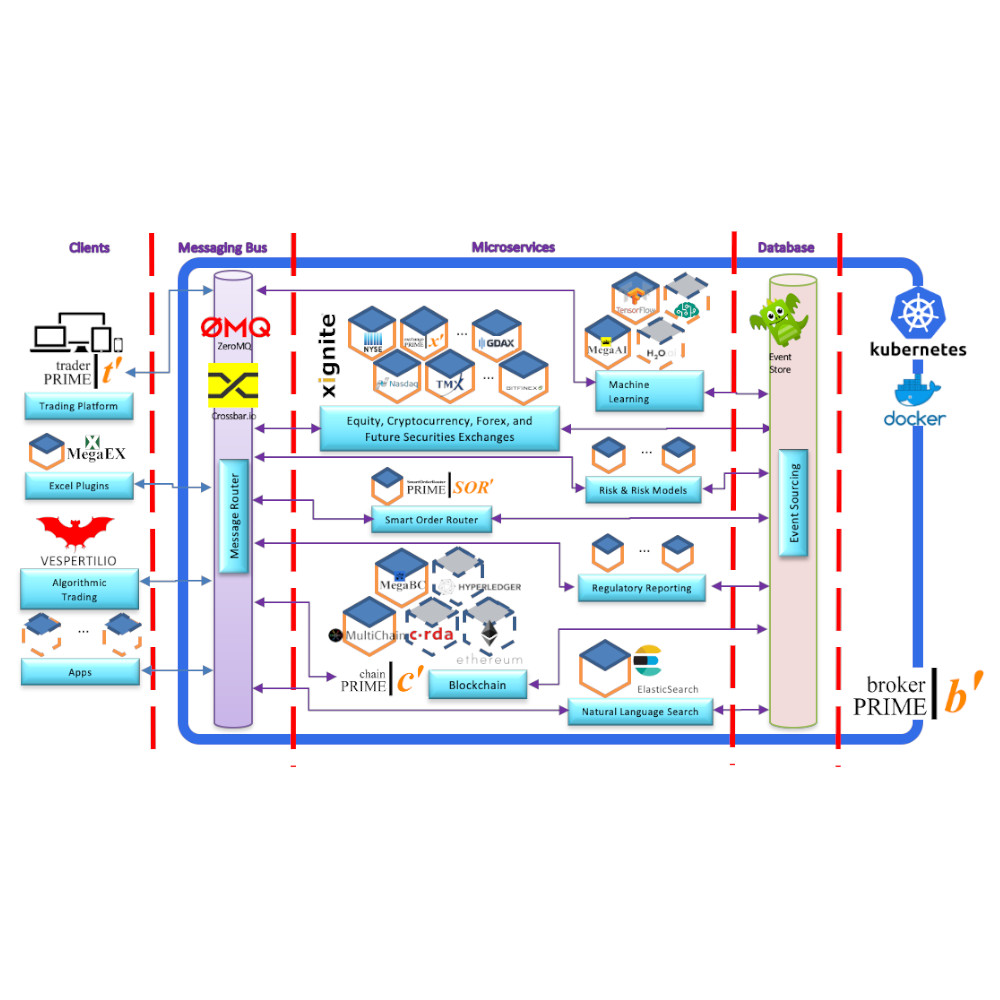
brokerPRIME is a resilient, self-healing, elastic, and horizontally scalable collection of loosely coupled message-driven microservices, deployed as containers in a clustered environment, backed by a functional database.
The business case
- Downtime is measured in lost clients. A brokerage's market share depends on being open when the market moves. Self-healing via auto-placement, auto-restart, auto-replication, and auto-scaling turns infrastructure failures into non-events.
- Your data model can't drift from your business. Event sourcing keeps the database as a sequence of immutable state-changing events, so materialized domain objects always agree with what the business actually did — no synchronization project, no reconciliation desk.
- Change without re-platforming. CQRS and microservices let teams ship new capabilities independently — the difference between a roadmap measured in quarters and one measured in weeks.
- Elasticity is a cost advantage. Horizontal scaling means you pay for the capacity you use during market hours, not for peak-forever.
Architecture in depth
No relational database
First and foremost, we ditched the relational database (RDBMS) altogether, opting instead for a functional database — in particular, Event Sourcing. The database is essentially a sequence of state-changing events. Event transactions are immutable. There is no delete operation. The store acts as the system of record and can be used to materialize the domain objects. This simplifies complex domains by avoiding the need to synchronize the data model and the business domain, while improving consistency, performance, scalability, and responsiveness.
Command Query Responsibility Segregation (CQRS)
CQRS demands that every method be either a command that performs an action, or a query that returns data to the caller — but not both. In Bertrand Meyer's words: "Asking a question should not change the answer." Because CQRS splits the system into separate services, it takes full advantage of Event Sourcing. The pattern enhances scalability, simplifies the complexity of the domain, increases flexibility, and provides greater adaptability to changing business requirements.
Message-driven
"Message driven" should not be mistaken with "Event driven". A message is an item of data sent to a specific destination. An event is a signal emitted by a component upon reaching a given state. A message payload can contain an encoded event. Using only non-blocking and asynchronous messages among components guarantees loose coupling, isolation, and decoupling of runtime instances from their references. It also allows recipients to only consume resources while active, hence less overhead. Monitoring of message queues leads to load management, elasticity, and flow control.
Microservices
Microservices provide agility to a complex development — more so than the monolithic, large, and hard-to-move codebases that traditionally power enterprise applications. Nevertheless, beware the challenges ahead: microservices without orchestration ends in disaster. While microservices is a variant of the service-oriented architecture (SOA) style, there are a few differences — microservices is loosely coupled, and the granularity of functionality and scope is finer. In practice, any single SOA service can be divided into multiple microservices. Microservices provide autonomy, enable greater agility, and require orchestration.
Orchestration
brokerPRIME's microservices span multiple containers, deployed across multiple server hosts. Kubernetes provides the orchestration and management capabilities required to deploy containers at scale for these workloads. Orchestration allows building services that span multiple containers, scheduling these containers across a cluster, scaling them, and managing the health of the containers over time. Self-healing is achieved by auto-placement, auto-restart, auto-replication, and auto-scaling.
Architecture and design sessions
Traditionally, for such complex domains, it would take weeks to create the architecture blueprints. This can be reduced to days. "Event storming" is one way to approach the design and architecture, as explained by Alberto Brandolini — an exploratory way of finding the problems in a domain. Greg Young also suggests focusing only on one process, the purpose being to discover service boundaries.